COTE DE TEXAS

Fabric Searching on the Cheap

94 comments


image

My current favorite “cheap” fabric:   Calico Corners sells this fabric as Vienna Flowers Vintage for $31.99.  Robert Allen sells it as Eleria Green Tea, wholesale it is a lot less.


I was searching  for an inexpensive fabric for a client when an email from Calico Corners caught my eye.  I’ve been disappointed with Calico Corners ever since they changed policy – no more in-store stock, you can only order fabric.  Well, I’ve got the Decorative Center for that, if I want to wait.  Calico Corners was always good for that last minute job – run in and run out.  I’m not sure if this is a chain-wide policy change, but that’s how it is in Houston.  Wow – what a great business decision – make your customers wait.   I haven’t been back since.   Still, a quick look at some of their “newer” fabrics caught my eye.  Some I’ve been seeing around a lot lately. 


image

For instance, this blue and white Ikat from Calico Corners seems to be everywhere these days.  The cotton Kalah Ikat comes in both navy and spice, retailing at $23.99.


image

A recent spotting of the Calico Corner Kalah Ikat was on the online magazine Lonny when they showed Ellie Somerville’s apartment.


image Recently, Lauren Liess of Pure Style Home used two panels of the Calico Corners Kalah Ikat, framed in this dining room.  I think this is such a great idea!  The bright blue bounces off the deep red painted walls. 


image Apartment Therapy ran this question about Tyler Dawson’s curtains.   She used the Suzanne Rheinstein ikat by Lee Jofa.  Pricey, certainly.   But doesn’t it look very similar to the Calico Corners Kalah Ikat in spice?  


image

The spice Kalah Ikat from Calico Corner is a dead ringer for the much more expensive Lee Jofa Ikat.


image The Suzanne Rheinstein Ikat for Lee Jofa comes in several colors.  I prefer the softer blue than this brighter blue. It is a gorgeous fabric.  But, not everyone can or wants to spend the money when there is another fabric that looks very similar and costs much less. 


t

image

The interior designer and blogger Urban Grace used the pricey Rheinstein ikat in her kitchen window.  HERE.


 image


image

As always – first check with Lewis and Sheron Textile Co. when looking for inexpensive fabric copies.   They seem to beat everyone’s prices.   Above are two ikats that rival the originals and the Calico Corners copies. 


image

Another popular fabric that is often copied is the Suzani.    The suzani from  Calico Corner reminds me of two different fabrics.   


image

Their “Suzanni” shown on the ottoman comes in three colorways at $32.99


[bandwgilbane.jpeg]

It is almost a dead ringer for the beautiful Carlton V Suzani, shown here in a bedroom designed by Sara Gilbane.   Gorgeous!  I can only imagine how much this room cost in fabric, the  Carlton V is not cheap and certainly the Calico Corners fabric would be a huge savings. 


imageThe Calico Corner Suzanni in Jewel is a copy of one of the more popular  Brunschwig and Fils suzani, Dzhambul. 


image Brunschwig’s suzani included in this tent’s fabrics.


image The Brunschwig suzani first showed up in the blogosphere here in this bedroom by Krista Ewart in 2007.


image Popular blogger Style Court covered her bench a year earlier in 2006 – in Dzhambul.   Recently, the fabric has shown up again.


image

First online magazine Lonny showed wing chairs covered in the Brunschwig suzani at  Tom Dolby and Drew Frist’s Hamptons house.  I love the way the walls are painted to blend with the fabric.


 image

And then, blogger Little Green Notebook used it for her parent’s living room.  Except, here – she actually used the copy of the fabric from Lewis and Sheron.


 image

While Calico Corners charges $32.99 for their copy of the Brunschwig’s fabric, Lewis and Sheron charges only $24.98 for their copy. 


image

Calico Corners line of assorted suzanis. 


image

The Calico Corner’s Corazon Seaglass suzani at $58.99 reminds me of the Donghia suzanis.


image

The Donghia Suzani is much more expensive than the Calico Corners Corazon suzani, but its a good copy.


 image

More favorites of the new fabrics from Calico Corners are from the French Stripes Collection.    Much quieter than the other bold ethnic prints, these cotton/linen blends are from $29.99 to $36.99 and they seem to be an answer to the burlap and natural linen craze of the past year. 


 image

Here, designer Carol Glasser used pricey original ticking as a table cloth.


image

From Veranda, original ticking is more costly than the  Calico Corners copies.   Shannon Bowers interior.


image This Calico Corners fabric, Florabunda, is a a linen blend for $22.99.   It reminded me of a Bennison print, all faded with wonderfully large flowers.


image

It’s extremely hard to copy a Bennison fabric since they are hand blocked, but their Dragon Flower does seem similar to the Florabunda I think.


image

   Ballard Designs’ Suzanne Kasler Collection recently debuted beautiful new linens.  The soft blue is a favorite of mine.  All linens, shown above, retail for $32.00 but are now on sale for $28.00.


image

Suzanne Kasler’s linens for Ballard Designs.  The blush and mineral are both so pretty. 


 image

Robert Allen’s Eleria in Green Tea and Biscotti


When it was all said and done, the fabric I want for my client is a personal favorite – the Robert Allen linen, Eleria.   I first saw this fabric in a house nearby mine and fell in love with it.  This neighbor had used the fabric in the biscotti colorway for curtains in the master bedroom.  The biscotti has a lot aqua in it, while the green tea colorway has raspberry and peacock blue.   The green tea colorway will be perfect against the coffee brown linen I plan to use on my client’s sofa.  The best part is the price, it wholesales  for under $20 and that can’t be beat. 


image

A closeup of the green tea colors – the leaves are a light and dark brown which picks up the sofa colors.   I want to use two raspberry velvet pillows on the sofa, along with one or two Eleria pillow. 


But of course, others have used this fabric before me.  Again, the blogger Little Green Notebook used it for curtains in a client’s bedroom.   She found her fabric at Calico Corners under the name Vienna Flower Vintage for $31.99 HERE.    Interestingly, the Biscotti colorway is available at Calico Corners, but only in silk!  It costs $57.99   A lot of the online fabric houses sell Eleria, mostly for around $30.00.  


image

Little Green Notebook used Eleria Green Tea for curtains in a master bedroom HERE


image


For my client, I plan to use the Eleria for curtains, just like these above.  It looks great against her existing fabrics and wall color, but the problem is that she doesn’t like the birds.  I am trying to explain to her that once the fabric is hanging she won’t really see the birds – as you can tell in this picture.   I like how the dark brown shades look against the fabric, which is exactly how I want to use it, if only she can get over her bird phobia.  Wish me luck!!!


Do you have a favorite “cheap” fabric you like to use?  


NOTE:   The new Skirted Roundtable is now ready for listening.  It’s just the three of us, Linda, Megan and myself, talking about all the recent changes in the magazine world.  Thank you for your continued support – to listen, go HERE.

One House – Three Designs

53 comments


mca5

Architect Bobby McAlpine’s former house in Montgomery, Alabama was modeled after Edwin Lutyens’ Homewood. 


image

Homewood was built in 1901 for Dowager Lady Lytton, who was to soon become his mother-in-law.  The Luytens children spent summer holidays at Homewood, so it truly was a family house – held by the Luytens until 1973 when it was sold.  Today it is a bed and breakfast inn.  In this picture of the back side of Homewood, you can see the three large windows which McAlpine used as inspiration.   Also notice the two wings that flank the windows, another feature that McAlpine incorporated along with the lilting silhouette.


image 

The three large doors that McAlpine used to emulate Homewood’s three large windows.  Like Homewood, there are two small wings that flank these windows. 


imageAn early picture of the Montgomery house showing the side entrance before the vines covered the pergola over the entrance.  The carriage house is seen at the very left.    


image

The front of Homewood.   Notice how McAlpine’s roof mimics the left side of Lutyens’ house.


image

Montgomery, Alabama.  Notice the shadow of the huge tree!   The photographer probably waited all day for this shot!    Above the doors is the window of one of the bedrooms.  Another matching bedroom is on the other side’s window above the pergola. 


image View that shows the small wing that flanks the three windows/doors on the side.  One wing holds the kitchen, another holds a bedroom.   (Is that a headless ghost running there?  What IS that?!!!)


Bobby McAlpine, a recent guest on The Skirted Roundtable, started out early.   He began drawing floor plans at age five.  When he was 12, he designed an addition to his house that his parents ultimately had built.    McAlpine was to oversee the contractor when he got home from school.   The contractor balked at taking instructions from the precocious 12 year old but McAlpine’s father told him to do so, or they would find another contractor who would.    His first commission came a year later when he was 13 and he designed a ranch house for a woman, complete with floor plans, all for under $100.   At 16, he designed a new house for his parents which they built – an experience that bonded the two men forever.   All amazing stories, but not really surprising, given the genius that is the man.   A gift from God like he possesses isn’t something one learns at college,   you are either born with it or not.   And Bobby McAlpine was born with his talent, in spades. 

The first house that McAlpine built for himself is located in Montgomery, Alabama.   Receiving much press, this house is usually the one that most first took notice of McAlpine, and it remains a favorite among the legions of his devotees.  Built in 1995, McAlpine was 36 and single at the time - he took inspiration (one of the few times he ever did so) from Edwin Lutyens’ Homewood.   McAlpine revealed on The Skirted Roundtable that he has visited the original Homewood and his house  is “so much better!”    Of course it is.   Though the Montgomery house resembles the English Cotswold style, McAlpine calls it “Monastery Modern.”   The floors are concrete tiles of irregular shapes.   There is no molding and no window trim., details left out to make the house feel “permanent and resonant.”

Although McAlpine had remodeled the house three times, the house was still missing something – a happiness that can only come when its shared with someone else.   He eventually sold the house to a “beautiful” young architect who works for his firm.   Today that architect, his wife and two children happily live in the 3 bedroom house which Bobby admits was designed for a bachelor.  There is true love in the house now, something that was lacking at the time for McAlpine.   It’s fascinating to follow the three decors that McAlpine installed – each is completely different from the other.   This story is about those three different stages of the same house.   Enjoy!


NOTE:    Bobby’s last name  is not pronounced Mc-AL-Pine, accent on the Pine.   Instead he pronounces it Ma-CAL-pen – accent on the CAL, so much harder to say it that way!!!!  And, Edwin Lutyens is a name I have also always mispronounced!   Ma-CAL-pen called him Lutch-ins.  Don’t even ask how I always pronounced Lutyens.


STAGE I:   A Self Portrait in Warm Greens

 image


Stage One:   Here how the house first looked when McAlpine moved in.  A mixture of beautiful antiques chairs and tables, the main living area is colorful in many shades of green.  The salon is two stories high, with a 70’ aisle or  landing that connects the two bedrooms upstairs.     The bottom of the front door is seen on the very upper left.    McAlpine calls this first stage his “self portrait.”     During this self portrait phase, he filled the house with things he loved and had collected:  An antique Flemish tapestry, a Dutch chandelier, a collection of corner chairs.    The dining room doubles as a work area:  the table is behind the sofa.  Alas, this decor was not to remain.  He states that he cycles every 3 years when he must either move or redecorate.


 image  Looking the other direction towards the antique limestone fireplace dating from the 16th century.   The house was built without moldings or window trims.   The landing or bridge runs between two identical staircases.   The floor is made of concrete pavers of irregular sizes. McAlpine says he loves chairs and his collection of antique Os de Mouton chairs is gorgeous.     


image

A view from the upstairs bridge overlooking the tapestry in the main living area below.   Notice how the huge column does not reach the ceiling!


image

Behind the fireplace is a small sitting room.   The cypress paneling here is on a grid, and is repeated throughout several other rooms.   You can see a bedroom through the paneling that opens like a door.


image  One of the three bedrooms (this one is downstairs in the wing) with its gorgeous twin beds and the long table between.   A modern bench is the surprise here.  Notice the beautiful trio of windows here that give the house its English Cotswold feel.   These windows are repeated in the kitchen which fills the opposite wing.


image The kitchen with its long row of windows.  This might be the kitchen that inspired all the farm sinks and no overhead cabinets!   (sorry for the bad picture splice!)


Stage II:   The White Interior

image

A few years after moving in, McAlpine decided to completely change his interiors.  All the greens, yellows and oranges are now gone, replaced with white.    Stage II is what Bobby calls his “white phase.”    He was celebrating, he had lots of parties, and he became the owner of a white greyhound that he wanted to match to his house.  I can really relate to that feeling!!!  Notice the beautiful column made into a side table. 


image  Looking towards the fireplace, Bobby added a very tall screen to play with proportions.   I LOVE the antique French barometer he has placed hanging on the screen.  And notice the side table – one piece of concrete atop two small sawhorses!!!  Upstairs, the window of one of the bedrooms is open to below.   


image

A long concrete table with logs underneath and candles above is settled in front of the wall of windows. 


  image

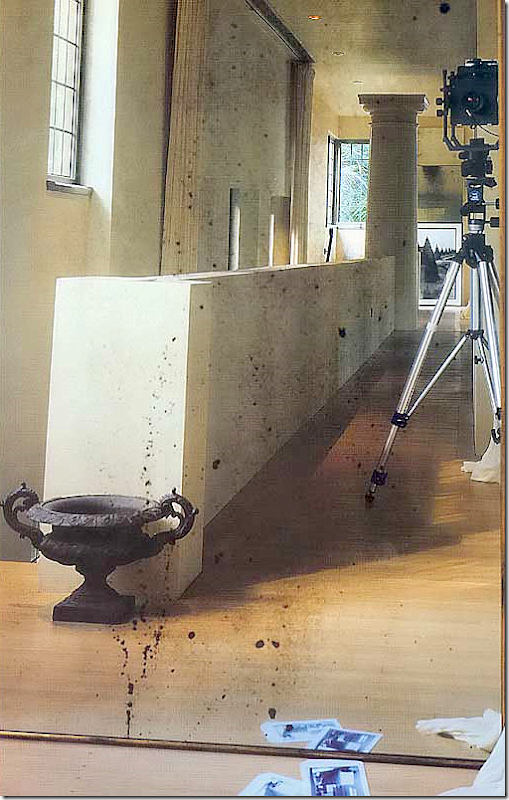
A beautiful concrete urns sits before the grid patterned wall.   Here, McAlpine mixes stools with chairs and a settee around the dining table – an early trademark of his.  Notice how the door to the bedroom is hidden in the paneling.


image

The upstairs bedroom where the bed, placed between two large pier mirrors, sits in front of the large side window. 


image

Reflection in the mirror shows the bridge upstairs between the two bedrooms. 


image The view again of the upstairs bridge and staircase.  I love all the concrete items he has in the house – like this orb in the corner on a pedestal.


STAGE III:   Dark and Serious

image


It’s difficult to realize that this is the exact same space as the White Phase, yet it is!  The third makeover goes completely dark.  For the first time a large dark striped rug covers the concrete floor.  This third phase which followed McAlpine’s white celebratory phase is called his introspective phase.  Here he wanted to “dim the houselights and contemplate all that had just happened and what was going to be.”   The walls were darkened with linseed oil and pigment.   Notice how beautiful and structural the rafters are that hold up the bridge.        Interior designer Susan Ferrier worked with McAlpine on this phase.   She is a partner with McAlpine Booth and Ferrier Interiors


image

A close up of the fireplace.  What a beautiful rug!   And the desk and chairs are all so beautiful.    I particularly love the map on the mantel.  During Phase III, the house became more decidedly masculine - a sanctuary, McAlpine states.    He was feeling vulnerable at this stage in his life and he darkened the walls so that they would envelop him and warm him, like a blanket.    The map of Bohemia allowed Bobby to pretend the house was in another country, where he could hide out until he could figure out where he needed to go next.   Actually, he ended up buying an old house in Nashville where he now lives with his partner, although his company remains in Montgomery.   


 image

Close up of the small McAlpine sofas side by side, which give more people arm rests, he says.   Notice the windows on this side are grids, like the others throughout. 


image

The stunning desk floats in front of the three doors that lead to the side courtyard.   The white curtains have been replaced with these darker ones made of chocolate brown mohair. 


 image A Saladino shelter sofa sits in front of the entry.   Interestingly on The Skirted Roundtable, McAlpine mentions John Saladino as the only “living” designer he admired.  


 image

Behind the fireplace, the space is filled with another shelter sofa and chairs.  


 image   Beautiful statue of a greyhound. 


imageThe kitchen is so gorgeous – I love the rafters, the bank of windows and the sconces flanking them.  


image

In the upstairs bedroom, this bed was designed by McAlpine, who has a line of furniture he designs for LEE Industries HERE.    I wish I could see the map!


image

The other side of the bedroom, seen above.  


 image

The modern and the antique - this juxtaposition is seen throughout this house.


After studying all three stages this house went through, I am not sure which version I prefer.  I might like the white version most.   There are things in the first version I liked too.  The third version, the dark one, is probably my least personal favorite simply because it is so dark – but I do love the furniture and the interior design of the third version.  So, it’s difficult to say which version I like best.  I’m going to say which one I would probably like to live in the most –  the white version, or Stage II, but include in that the bedroom from Stage I and the antiques from Stage III.   What about you?   What is your favorite of the three styles? 


Be sure to listen to the Skirted Roundtable with Bobby McAlpine HERE

And to order his book, The Home Within Us, go HERE.